.svg)
How a 35-year-old B2B Brand Automated Cross-sells And Made it Measurable


About WBC
Some businesses sell products; others sell solutions.
For more than 35 years, WBC (The Wine Box Company) has been doing exactly that.
It all began in 1989, when two friends, Tim Wilkinson and Andrew Wilson, returned from France with just a £5,000 Prince's Trust loan and a simple idea: create beautiful wooden wine boxes that businesses could proudly put their names on.
What started in a small warehouse soon grew into something bigger.
Today, WBC is the UK's and Ireland's leading supplier of premium packaging for the drinks, food and gifting industries. Their customers - wine merchants, delis, breweries, corporate gifters - expect the products they ship to arrive beautifully presented. Their catalogue now includes more than 1600 products, ranging from luxury gift boxes and fabric bags to retail display and protective packaging.
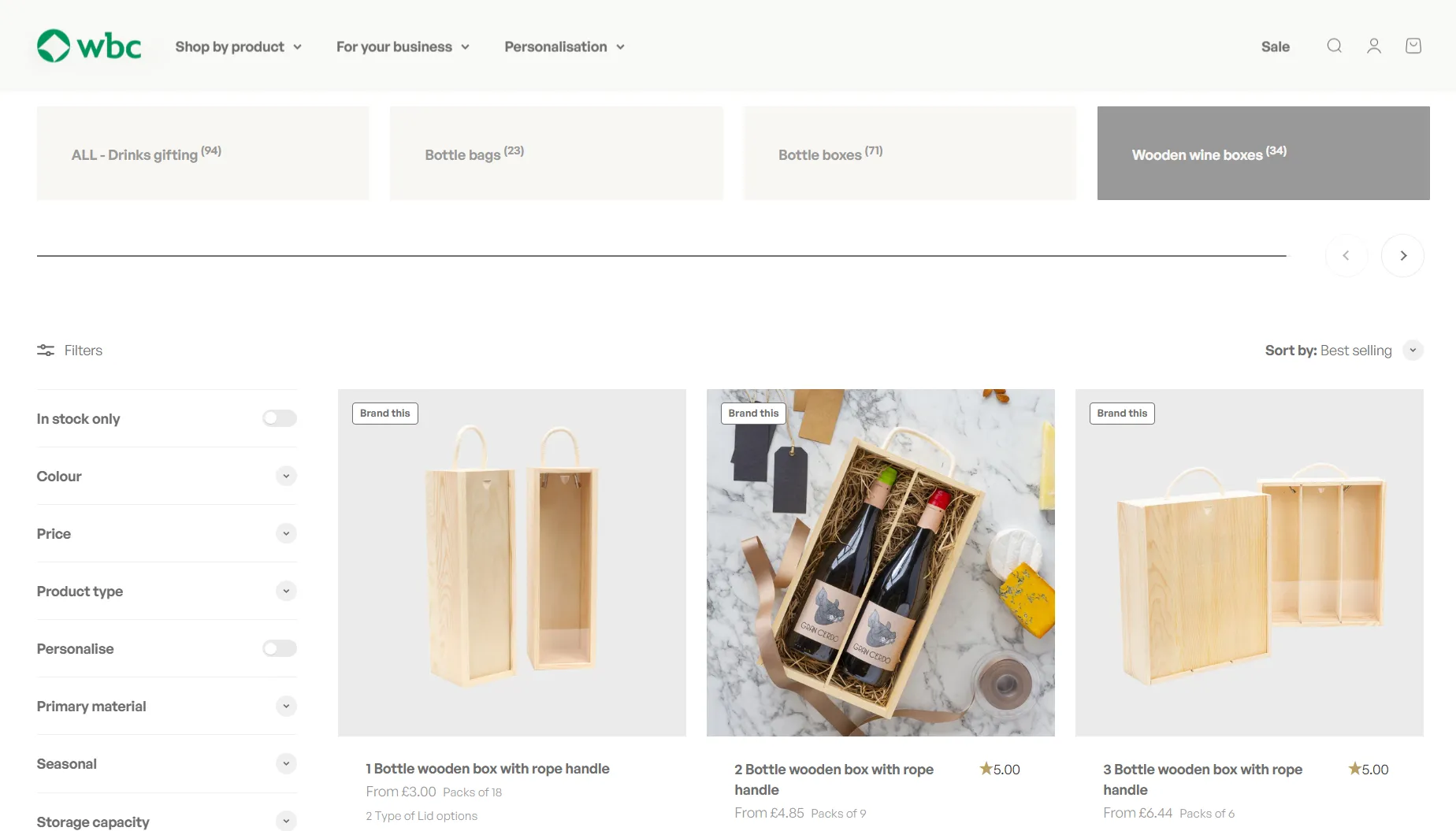
The Challenge
WBC's Shopify store wasn't a standard setup.
Over the years, the team had heavily customized it to support their B2B business, with fixed pack sizes, metafield-driven product logic, and customers who typically buy in bulk. While those customizations made the store powerful, they also meant that many third-party apps couldn't work seamlessly with the product page.
To help customers discover complementary products, the team had built a "Works Best With" section. The idea was simple: recommend related products that customers were likely to need.
The challenge was keeping it up to date.
Every product pairing had to be created and maintained manually. There were no automation rules, no intelligent recommendations, and no easy way to scale as the catalogue grew. Over time, updating the recommendations became increasingly difficult.
The recommendations weren't delivering the expected results. Their placement was too subtle; very few interacted with them.
"We didn't have aggressive enough positioning without ruining user experience, and the manual process took too much time. We ultimately didn't know the impact our efforts were having."
- Alex Wotton, Ecommerce Executive at WBC,
When WBC started evaluating cross-sell apps, narrowing down the options was easy.
Finding one that worked with their highly customized Shopify store wasn't.
Most apps were designed for standard Shopify themes, but WBC needed the flexibility to work with a heavily customized storefront. For them, flexible widget placement wasn't a bonus - it was essential.
The Solution
The Setup: Building Something That Didn’t Exist In the App
Selleasy stood out as questions came up during the trial, the team was quick to help, giving WBC the confidence that even future challenges could be handled.
"Reviews were great and plentiful, which was good. Very reasonable price. Flexibility of where the cross-sell ad appears was a huge selling point - we custom code our site, so we needed that flexibility."
Everything WBC needed at the foundation - flexible widget placement, automated recommendations, and the Product Add-ons Pop-up - is available on every Selleasy plan. But their requirements went a step further, so WBC chose Selleasy's Enterprise plan to add a bespoke layer on top.
Instead of trying to fit the store into the app, the Selleasy team worked closely with WBC to build a solution that fit how their business already operated.
Several customizations were developed specifically for their store.
What Selleasy custom-built for WBC
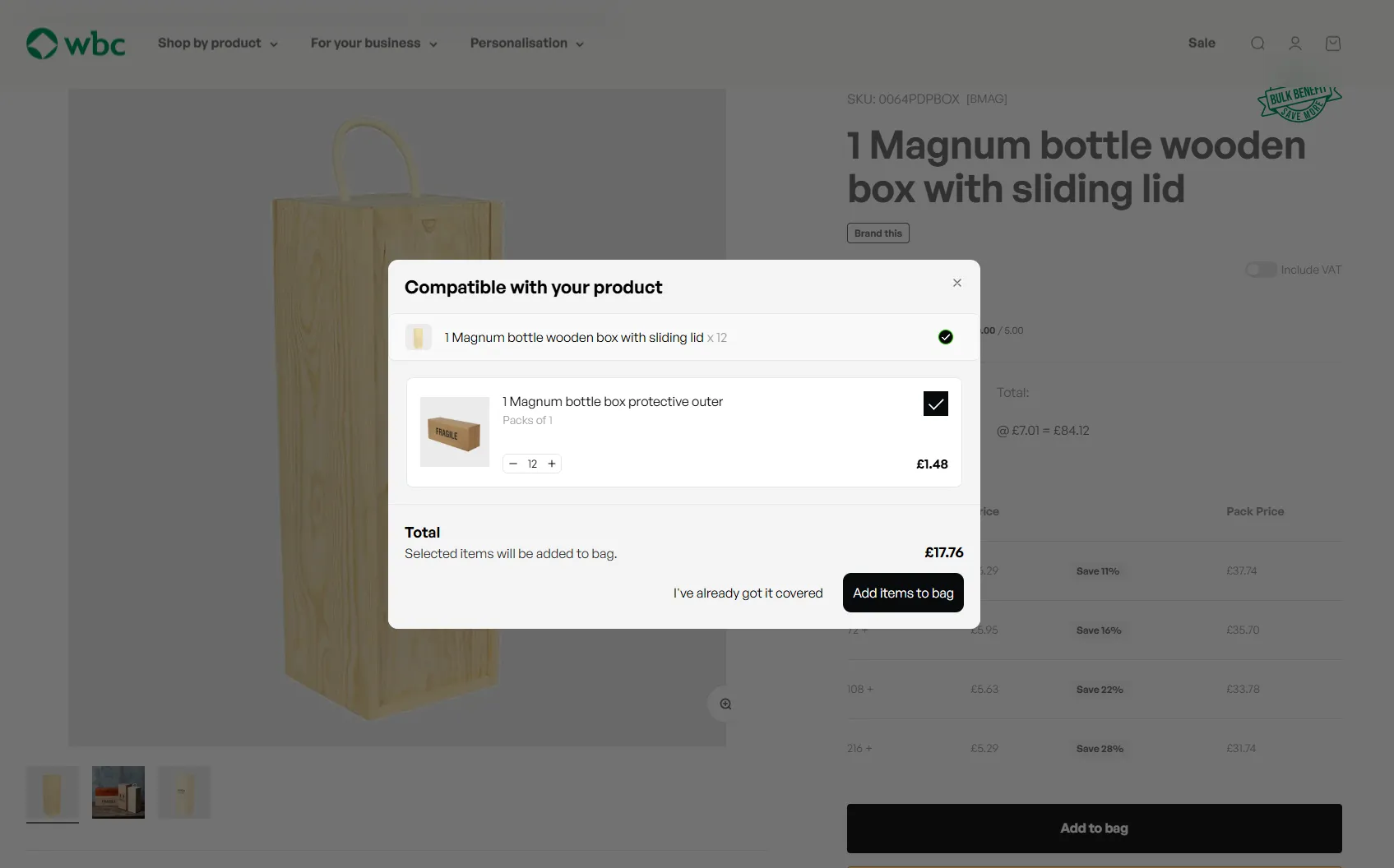
All of this comes together in a single Product Add-ons Pop-up. As soon as a customer adds a product to their cart, they're presented with relevant complementary items - already matched to the correct quantity and displayed with the right information. There's no page reload or interruption, just a timely recommendation when customers are most likely to add another item.
Most importantly, the entire process replaced a manual system with an automated one.
What once required constant maintenance now runs in the background, consistently delivering relevant cross-sell recommendations with no ongoing manual effort.
The Results
The impact was clear - and Alex believes the real number is likely higher. Customers who discover a product through a Selleasy recommendation and buy it in a later order aren’t counted in that 9%.
Why the real number is likely higher
The 9% reflects only cross-sell revenue that can be directly attributed to the app. Repeat purchases of items first discovered through a recommendation fall outside it - so the true contribution to revenue is almost certainly larger than the tracked figure suggests.
"We've seen a big impact from Selleasy - it easily justifies the price we pay. The true impact is difficult to measure as repeat purchases for items originally added through cross-sell aren't included."
The operational benefits have been just as valuable.
The team no longer spends time maintaining manual product pairings. Cross-sell recommendations are now powered by the store's own product data, and for the first time, WBC can see exactly what customers are clicking, adding to their cart, and purchasing.
What was once a manual process has become an automated, measurable part of their growth strategy
A Partnership That Goes Beyond The App
Alex's summary says it best:
"Amazing support and the app pays for itself many times over. Bit of a no-brainer."
For any merchant, that's the ultimate measure of success: the value it generates outweighs the cost. For WBC, the answer has been a clear yes.
But the value extends beyond the revenue.
Alex also points to something that's just as important: confidence. Running a custom-built B2B store means new requirements are inevitable. Knowing that the Selleasy team is there to help whenever those challenges arise gives WBC the confidence to keep evolving their store without worrying about whether their cross-sell solution can keep up.
That trust, built during the trial and strengthened throughout the Enterprise implementation, has become just as valuable as the app itself.
.svg)
.svg)
.svg)


.svg)