


Most upsells suggest products that look related. For a car parts store, that's not enough. A part has to fit the car, or it's useless.
Performance Chip Tuning sells over 8,000 parts for around 70 car makes. Every make has many models. Every model comes in different years and engine sizes. And a part that fits one car might not fit the next.
The problem
Performance Chip Tuning sells performance chips, air intakes, exhaust parts, ignition coils, and much more, for almost every car brand.
They wanted to recommend extra parts to shoppers. But there were a few things to account for:
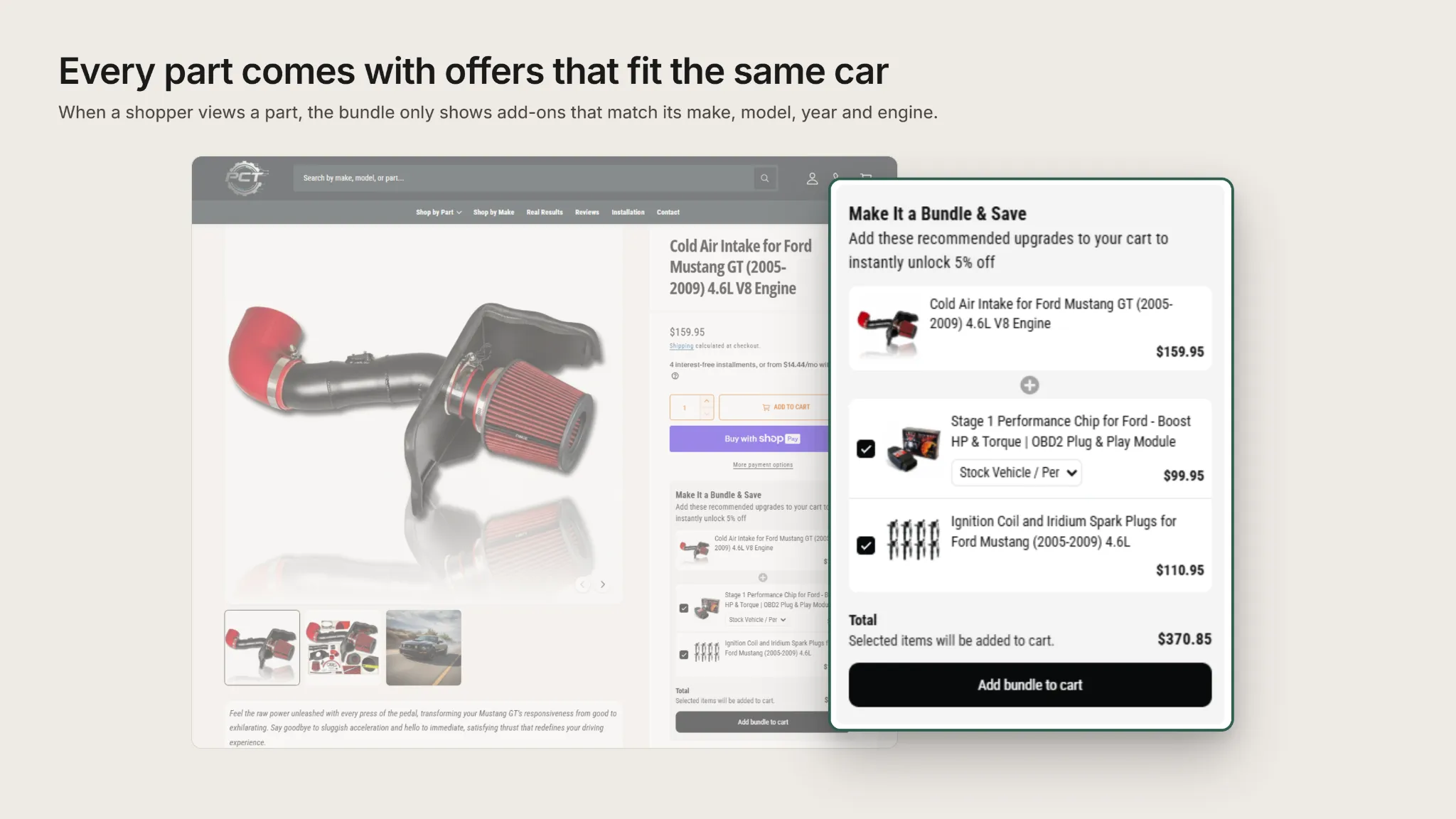
- Every recommended part must match the shopper’s exact car, including the make, model, year, and engine. For example, a Cold Air Intake for a Ford Mustang GT (2005–2009) 4.6L V8 Engine should only show parts compatible with the same vehicle specifications.
- The recommended part’s year range must fall entirely within the shopper’s car’s year range. For example, for a Ford Mustang GT (2005–2009), a part listed for 2006–2008 is compatible, but one listed for 2007–2010 is not, as it extends beyond the car’s year range.
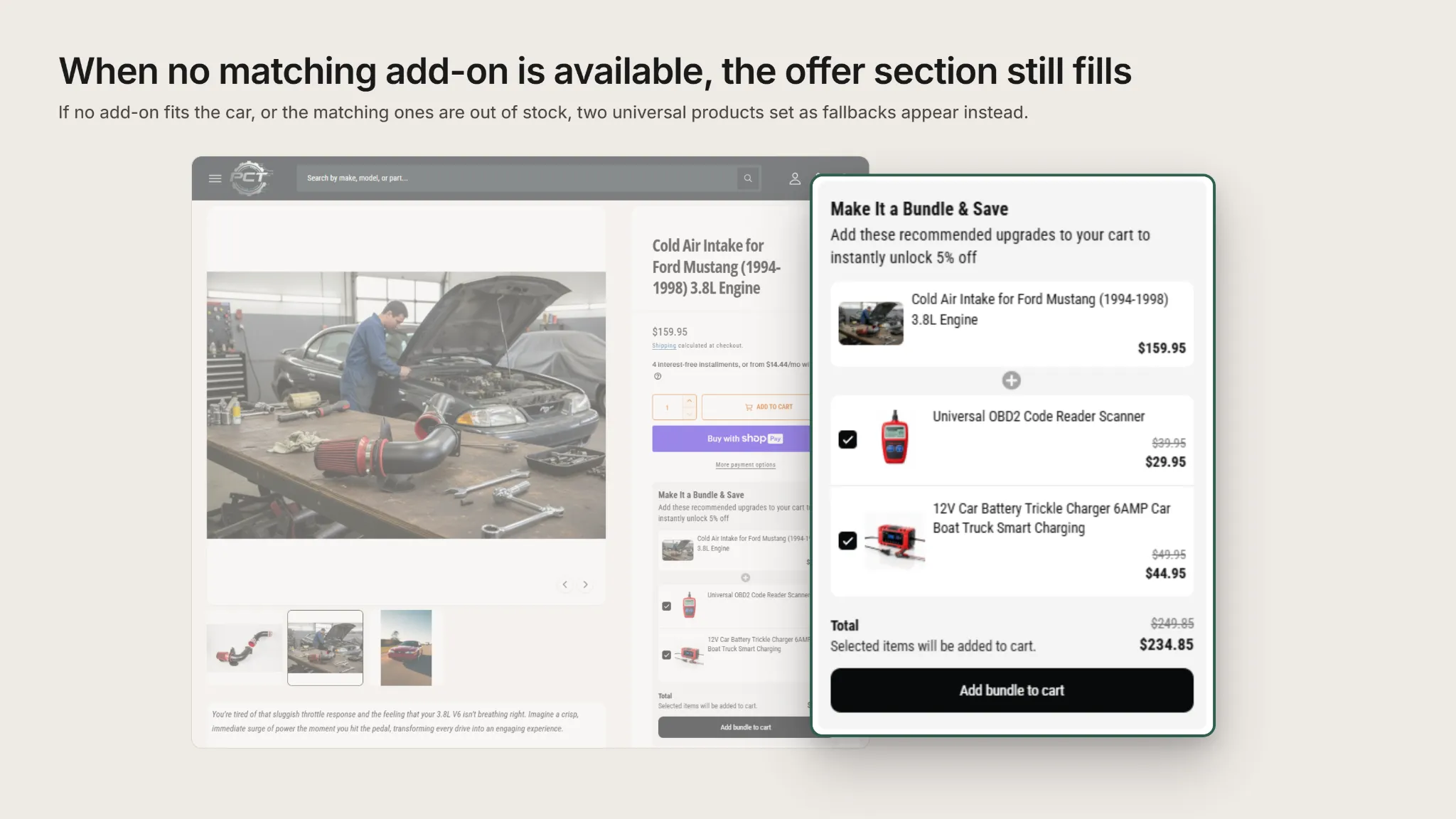
- Some cars wouldn't have a matching part, or the part could be out of stock.
- New products are added all the time.
Why the usual setup didn't work
Setting up offers by hand meant one offer for every make, model, year range, and engine size. With a catalogue this big, that's thousands of offers.
Every time the store added a new product, someone had to go back to the admin and create more offers for it.
It was slow, tiring, and easy to get wrong. One mistake and a shopper could see a part that doesn't fit their car.
How we set it up
The store already had four product metafields on every product: Make, Model, Year, and Engine capacity. We used these to build one offer powered by Selleasy AI.
Step 1
Matching rules for Selleasy AI
Selleasy AI was used to match make, model, and engine capacity exactly. The year range of the recommended part has to sit inside the year range of the car being viewed.
Step 2
A fallback for every car
If no matching part is available or it's out of stock, the offer shows two universal products that fit any car. So the offer is never empty.
Since Selleasy AI reads each product's name and details, new products get the right recommendations on their own. No new offers to set up.
The best part? The store never has to touch the offer when the catalogue grows.
See how Selleasy AI works.
Is this right for your store?
This works well if your products only fit certain customers, and your catalogue is too big to set up offers by hand.
Think:
- Car, bike and truck parts
- Phone cases and accessories for specific models
- Printer ink, filters and spare parts for specific machines


