.svg)
When to Use Volume Discount and When to Use Loyalty Points
Last updated on
May 15, 2026
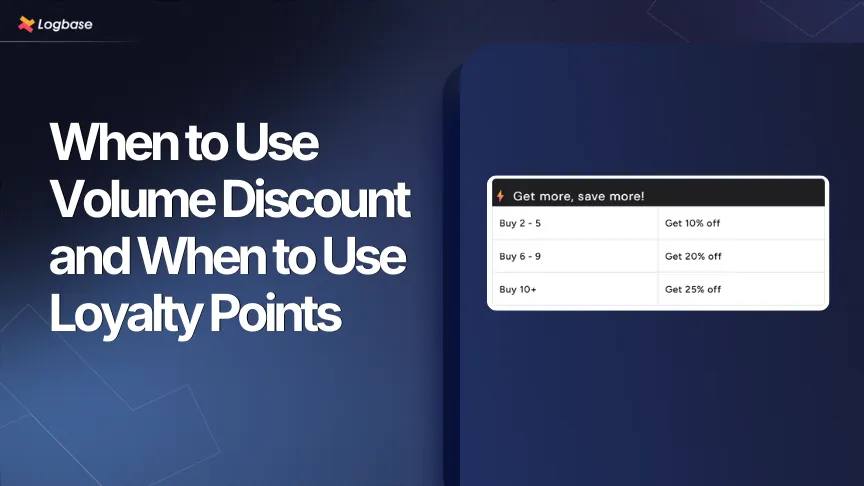
You've got two big tools to grow your Shopify store: volume discounts and loyalty points. Both bring in sales. Both keep customers happy. But here's the catch - using the wrong one at the wrong time can quietly cost you thousands in margin or missed repeat orders.
A volume discount makes sense when you want a bigger cart today. A loyalty program makes sense when you want a customer who buys 10 times this year. Mix them up, and you're either burning margin or losing repeat sales.
This guide breaks down exactly when to use each - with real brand examples, store-type fits, and 2026 data. By the end, you'll know which lever to pull, when to pull it, and how to use both without hurting your bottom line.
Quick stats:
- Stores with quantity discounts see a 15–27% lift in AOV (WizzCommerce, 2025)
- Loyalty members spend 67% more lifetime than non-members (Bond Brand Loyalty)
- Customer acquisition costs are up 222% over the past decade (Shopify, 2025)
- The average Shopify store has a 20–30% repeat customer rate - top performers hit 40–60%(rivo blog)
What Is a Volume Discount?
A volume discount lowers the price per unit when a customer buys more in a single order.
Quick example:
- Buy 1 t-shirt → $20 each
- Buy 3 → $18 each (10% off)
- Buy 5 → $15 each (25% off)
The customer saves money now. You move more units now. It's a fast-acting deal.
Common volume discount types:
- Quantity breaks - buy more units, pay less per unit
- Tiered pricing - different discount rates at different quantities
- Cart-total tiers - spend $100 = 5% off, spend $200 = 10% off
- BOGO offers - buy one, get one free or half off
- Wholesale pricing - bulk pricing for B2B buyers
Cumulative vs non-cumulative - know the difference:
- Non-cumulative: applies to a single order (most common)
- Cumulative: tracks total purchases over weeks or months - basically a loyalty discount in disguise
Most Shopify stores use non-cumulative volume discounts. Logbase's Dealeasy app - rated 4.9 stars with 540+ reviews on the Shopify App Store - handles both types, plus bundles and BOGO, in one dashboard.
What Are Loyalty Points?
Loyalty points reward customers over time, not in one transaction. Customers earn points for buying, signing up, leaving reviews, referring friends, or following on social. They redeem those points later for discounts, free shipping, or free products.
It's a long game. The first sale is just the start.
Ways customers earn points:
- Making a purchase
- Creating an account
- Leaving a product review
- Referring a friend
- Following on Instagram or TikTok
- Birthday or anniversary
- Reaching a VIP tier
Ways customers redeem points:
- Percentage off discount
- Free shipping
- Free product
- Store credit
- Exclusive access or early drops (experiential rewards)
This is where Yuko fits. Yuko is a Shopify retention platform that handles points, VIP tiers, referrals, reviews, and rewards in one app. Yuko also lets customers earn points for leaving reviews - creating what we call the review-loyalty flywheel: more reviews → more social proof → more sales → more points → more repeat orders.
The Core Difference (In One Line)
Volume discount = bigger basket today. Loyalty points = bigger lifetime value tomorrow.
The Psychology Behind Each Tool
Understand the why, and you'll set them up better.
Volume discount taps into:
- Loss aversion - "If I don't grab this now, I'll pay more later"
- Decoy effect - A 3-pack at $50 makes a single $20 item look weak
- FOMO - Limited-time tiers ("3 days only") drive urgency
- Perceived savings - Showing "You save $12" beats showing "$48 total"
Loyalty points tap into:
- Endowed progress - "I'm 80 points away from a reward"
- Status - VIP tiers like Gold or Platinum feel special
- Reciprocity - Customers feel they owe the brand more business
- Sunk cost - "I've earned 500 points, I don't want to lose them"
Watch this trap: DealHub research shows a 50% quantity increase is psychologically equal to a 33% discount. So massive discounts often aren't needed - smaller percentages work just as well.
When to Use Volume Discount (5 Clear Scenarios)
1. You sell consumables or stock-up products
Coffee beans, dog food, supplements, candles, soap. People stock up. Volume discount makes them stock up more. One coffee subscription brand offered "Buy 3 bags, get 15% off" and saw AOV jump 22% in two months.
2. You run a B2B or wholesale store
Wholesale buyers expect price breaks. If you don't offer them, they go to a competitor. Big-name examples: Uline, Grainger, Fastenal all use tiered volume pricing. Shopify's native B2B quantity breaks (April 2026) only work for company accounts - apps like Dealeasy open volume pricing to all customers.
3. You need to clear slow-moving stock
Sitting on 500 winter jackets in March? A volume discount moves them fast. Pair it with a deadline ("3 days only") for extra punch. This is what Costco does best - they use bulk pricing to keep inventory turning fast.
4. You want a quick AOV boost - no long setup
Volume discount works in days. Loyalty programs take weeks to build momentum. For flash sales, BFCM, or new launches, volume discount is the right tool.
5. Your store is new (under 6 months old)
New stores don't have enough returning customers for loyalty to pay off. Get the first sale first. Build your customer list. Then layer in loyalty.
When to Use Loyalty Points (5 Clear Scenarios)
1. You sell products people buy again and again
Skincare, supplements, pet food, snacks, makeup. If a customer buys once, they probably need to buy again in 4–8 weeks. Sephora's Beauty Insider has 25M+ members - and is one of the biggest reasons Sephora customers don't shop elsewhere.
2. You want to lower customer acquisition cost (CAC)
With CAC up 222% over the past decade (Shopify, 2025), every cheap repeat customer matters. A loyalty program turns one-time buyers into 3-time, 5-time, 10-time buyers - without ad spend.
The Yuko loop:
- Customer buys → earns 100 points
- Leaves a review → earns 50 more points
- Refers a friend → earns 200 more points
- Redeems points on next order → buys again
- Repeat
3. You want brand advocates, not just buyers
Loyalty programs with referral built-in turn happy customers into a free marketing channel. Yuko's referral feature gives points to both the referrer and the new friend.
- 77% of consumers are more likely to buy from a brand referred by a friend (Nielsen)
- Referred customers have a 16% higher LTV than non-referred (Wharton)
4. You sell premium or specialty products
Higher margins (premium beauty, niche fashion, artisan food) make loyalty pay off fast. You can afford to give 5–10% in points because each customer's lifetime value is high.
5. You want VIP tiers and experiential rewards
Tiered loyalty (Bronze, Silver, Gold) makes top customers feel special. Starbucks Rewards members visit 5.6x more than non-members. Beyond discounts, modern loyalty programs reward with:
- Early access to new drops
- Exclusive products
- Free shipping forever
- Surprise birthday gifts
- Invite-only community access
Yuko supports VIP tiers and these experiential rewards out of the box.
Industry Cheat Sheet
Pro tip for replenishables: Pair loyalty with a Shopify subscription app like Recharge or Shopify Subscriptions. Subscribers get auto-applied points + automatic reorders = highest LTV combo.
Real-World Decision Framework
- Just starting (under 100 monthly orders) → Volume discount only
- B2B or wholesale → Volume discount first, loyalty as bonus for top accounts
- Consumables / replenishables → Loyalty is your main play
- AOV below $30 → Volume discount (loyalty math gets ugly at low AOV)
- AOV above $50 with reorders → Loyalty wins
- Single-product DTC → Volume + bundles
- Scaling past $10K/month → Run both
The Margin Math (Don't Skip This)
Many store owners launch loyalty without doing the numbers. Don't be one of them.
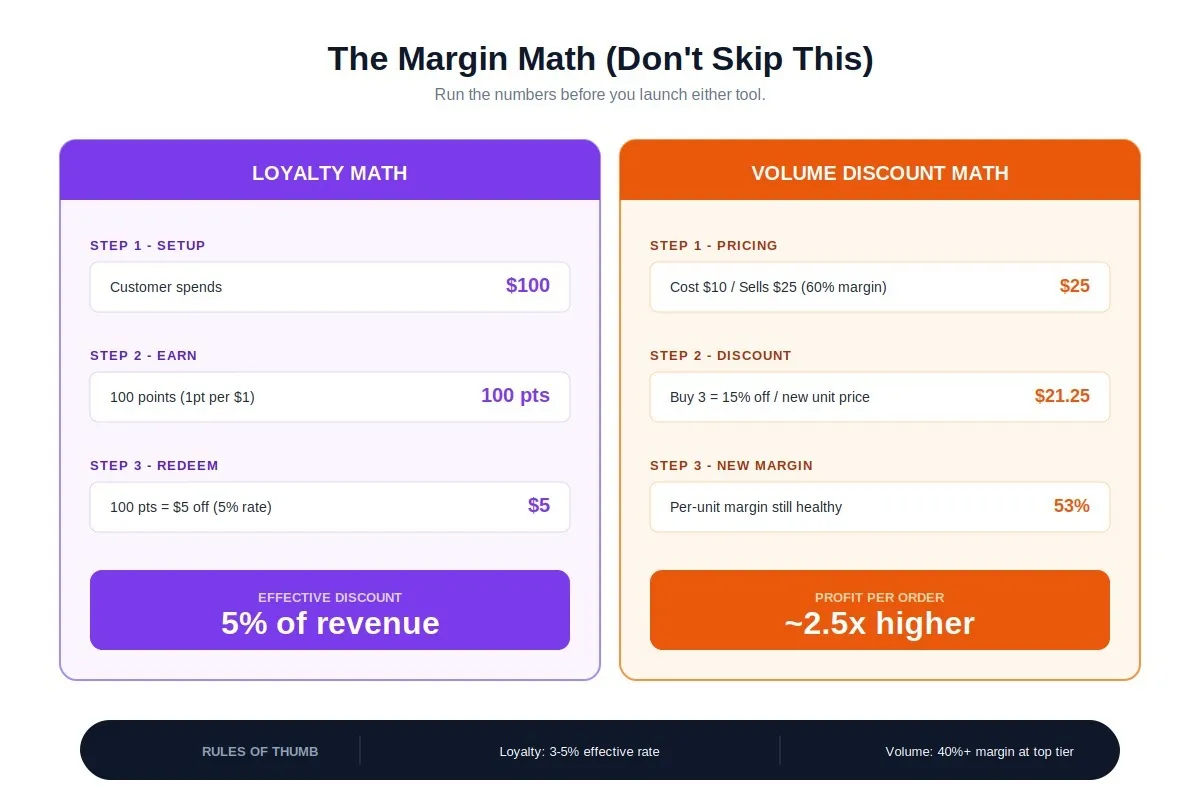
Sample loyalty math:
- Customer spends $100
- Earns 100 points (1 point per $1)
- 100 points = $5 off (5% rate)
- Effective discount = 5% of revenue
- With 30% gross margin → loyalty cost = ~17% of margin
Sample volume discount math:
- Product cost: $10
- Sells at $25 (60% margin)
- Buy 3 = 15% off → unit price drops to $21.25
- New margin per unit: 53% - still healthy
- Order size triples → total profit per order rises ~2.5x
Rules of thumb:
- Loyalty effective rate: 3–5% of revenue
- Volume discount cap: leave at least 40% margin at top tier
Healthy redemption rate: above 20% of issued points (Yotpo benchmark)
Can You Use Both? Yes - Here's How
The smartest stores use both, just at different stages. Think of it as The 3 R's: Reward, Recognize, Retain.
Stage 1 - Reward the first purchase (Volume Discount)
- Visitor sees "Buy 2, save 15%" tier on product page
- Adds 2 to cart, checks out
- Tool: Dealeasy by Logbase
Stage 2 - Recognize repeat behavior (Loyalty Points)
- Customer earns 100 welcome points
- Email: "You're 50 points away from $5 off"
- Comes back, redeems, buys again
- Tool: Yuko Loyalty
Stage 3 - Retain top spenders (VIP + Referrals)
- Hits Silver tier after 3 orders
- Refers a friend, both earn bonus points
- Leaves a review, earns more points
- Tool: Yuko VIP + Referrals
This is the acquire → retain → advocate loop.
Pro tip: Don't let customers stack volume discount + loyalty redemption + a 20% off code on the same order. Pick one or two max - your margin will thank you.
How to Communicate Each One
Volume discount messaging that works:
- "Buy 2, save 15%" (clear math)
- "You save $12" (dollar amount, not %)
- Progress bar: "Add 1 more for 20% off"
Loyalty messaging that works:
- "Earn 1 point per $1 spent"
- "100 points = $5 off"
- Customer dashboard showing balance + tier progress
- Email reminders: "You have 350 points expiring soon"
Yuko's Customer Hub lives inside the Shopify customer account, so points are always visible. No separate login. That alone boosts redemption by 30–50%.
Metrics to Track
Don't fly blind. Watch these numbers monthly:
- AOV (Average Order Value) - measures volume discount impact
- Repeat Purchase Rate - measures loyalty impact (target: 25%+)
- CLV (Customer Lifetime Value) - long-term loyalty win
- Redemption Rate - % of points actually redeemed (target: 20%+)
- Referral Rate - new customers from existing ones
Pair these with email win-back flows triggered after 30+ days of inactivity for max retention.
Common Mistakes to Avoid
1. Stacking too many discounts. Volume + loyalty + 20% off code = no margin. Set rules.
2. Setting loyalty too generous. Most stores aim for 3–5% effective discount. Higher = losing money.
3. Confusing tier structures. 3 tiers = simple. 7 tiers = confusing.
4. Hiding the rewards page. If customers can't see their points, they won't redeem.
5. Launching loyalty too early. Needs returning customers. If 90% of buyers are first-timers, do volume discount first.
6. Giving points only for purchases. Best programs reward signups, reviews, referrals, social follows.
Pricing Snapshot
Ratings from the Shopify App Store as of April 2026.
How to Set This Up in 30 Minutes
Step 1: Volume discount setup (10 min)
- Install Dealeasy from the Shopify App Store
- Set up 3 tiers max (e.g., 2 = 10% off, 3 = 15% off, 5 = 20% off)
- Pick top 5 products to start
Step 2: Loyalty setup (15 min)
- Install Yuko from the Shopify App Store
- Set 1 point per $1 spent
- Set 100 points = $5 off
- Add 3 ways to earn: purchase, review, referral
Step 3: Test for 30 days (5 min/week)
- Track AOV before/after volume discount
- Track repeat purchase rate before/after loyalty
- Adjust based on data
No coding. No developer. No headaches.
Final Take
Volume discount = quick win for AOV. Loyalty points = long win for LTV.
You don't have to pick one. The smartest Shopify stores run both - volume discount to make the first sale bigger, loyalty points to drive more sales over time.
If you're already using Dealeasy for volume discount, adding Yuko for loyalty is the natural next step. Together, they cover the full customer journey - from "first cart" to "5th repeat order."
FAQ
Q1: Can volume discount and loyalty points work on Shopify together?
Yes. Customers can earn loyalty points on a discounted volume order. With Yuko, points calculate on the discounted total by default - adjustable in settings.
Q2: Will loyalty points hurt my margin?
Only if you set them too generous. Aim for a 3–5% effective discount rate. So $100 spent earns ~$3–$5 in point value.
Q3: When should a new Shopify store add loyalty?
After 3–6 months of steady sales, or when 20%+ of orders are repeat customers. Before that, focus on volume discount and email capture.
Q4: Are volume discounts only for B2B?
No. Many DTC brands (apparel, candles, supplements, snacks) use them to lift AOV. Anywhere people buy multiple units, volume discount works.
Q5: What's the easiest loyalty program to set up?
Yuko is one of the simplest - most stores are live in under an hour. Free plan covers under 100 monthly orders.
Q6: Should I show points in cart and checkout?
Yes. Visibility drives redemption. Yuko shows points balance on product pages, cart, account, and (on Shopify Plus) checkout.
Q7: Can I run a volume discount on top of a loyalty redemption?
Most apps let you control this. Best practice: allow one or the other on a single order - protects margin.
Q8: What's the difference between cumulative volume discount and a loyalty program?
Cumulative volume discount tracks units bought over time and applies a price break. Loyalty tracks spend and gives points for many actions - purchases, reviews, referrals. Loyalty is more flexible.
Q9: What's a healthy loyalty redemption rate?
Aim for above 20%. If it's lower, your rewards are too hard to reach or too hidden. Check visibility first.

.avif)
.avif)

.svg)
.svg)
.svg)


.svg)