When and How to Use Shopify Volume Discounts (With Real Examples)
Last updated on
October 29, 2026
Everybody likes a deal, and a volume discount is one of the simplest: the more a customer buys, the less they pay per item. Used on the right products, it raises your average order value (AOV), moves stock faster, and gives shoppers a clear reason to buy from you instead of a competitor. Used on the wrong ones, it gives away margin
This guide covers why and when volume discounts work, five strategies to choose from, the do’s and don’ts, and real store examples using a Shopify volume discounts app.
Quick answer: Offer volume discounts on products customers buy more than one of. Keep the first tier small (5–10%), make sure your margin is well above the discount, and show the tiers on the product page, next to Add to Cart.
What is a Shopify volume discount?
A volume discount lowers the price per item as the customer buys more.
Shopify volume discounts are also called Shopify quantity discounts or Shopify tiered discounts, and they usually show up as a table or quantity selector on the product page.
Here is a typical tiered setup for a $40 shirt:
Why offer volume discounts?
Offer volume discounts to get customers to buy more units in a single order.
A well-planned volume discount increases average order value and profit per order without cutting prices across your entire store. It gives shoppers a clear reason to buy more from you instead of a competitor.
When volume discounts work (and when they don’t)
Volume discounts work best for products customers already buy in multiples, where your gross margin is well above the discount, and extra units are cheap to ship; they don’t work for thin-margin, one-time, heavy, or premium products.
- Customers already need more than one: consumables (coffee, supplements, skincare, pet food) and items bought in sets (socks, tees, candles, wine).
- Your gross margin is comfortably higher than the discount. Above 50% gives plenty of room; below about 30% gets risky.
- Extra units are cheap to ship and pack. Light, compact products benefit most.
- You have stock to move, such as end-of-season or overstocked SKUs.
- Your AOV sits just below a free-shipping threshold, so one more unit carries the order over the line.
Be careful with thin-margin products, one-time purchases (nobody needs two mattresses), heavy items, scarce stock, and premium brands where constant discounts cheapen the product. If your real goal is repeat purchases rather than bigger orders, read “When to use volume discounts and when to use loyalty points”.
Industries and products where volume discounts work best
The categories below have one thing in common: customers naturally buy in multiples or restock often.
5 volume discount strategies for your Shopify store
The five main volume discount strategies for Shopify stores are tiered pricing, BOGO, mix and match, spend or quantity thresholds, and wholesale tiers; most stores should start with tiered pricing.
Not sure which one fits? Use this table to find your match, then read that strategy below.
In Dealeasy: You can run all five strategies from one app. The offer shows on the product page or cart, and the discount applies automatically at checkout.
Real Shopify Store Examples Using Volume discount (With Dealeasy)
The 4 stores featured here show that volume discounts work best when the offer matches how customers buy.
Example 1: Canada Strong
Canada Strong
 3Free shipping
1Bulk pricing
2Buy more, save more
What you can learn from Canada Strong
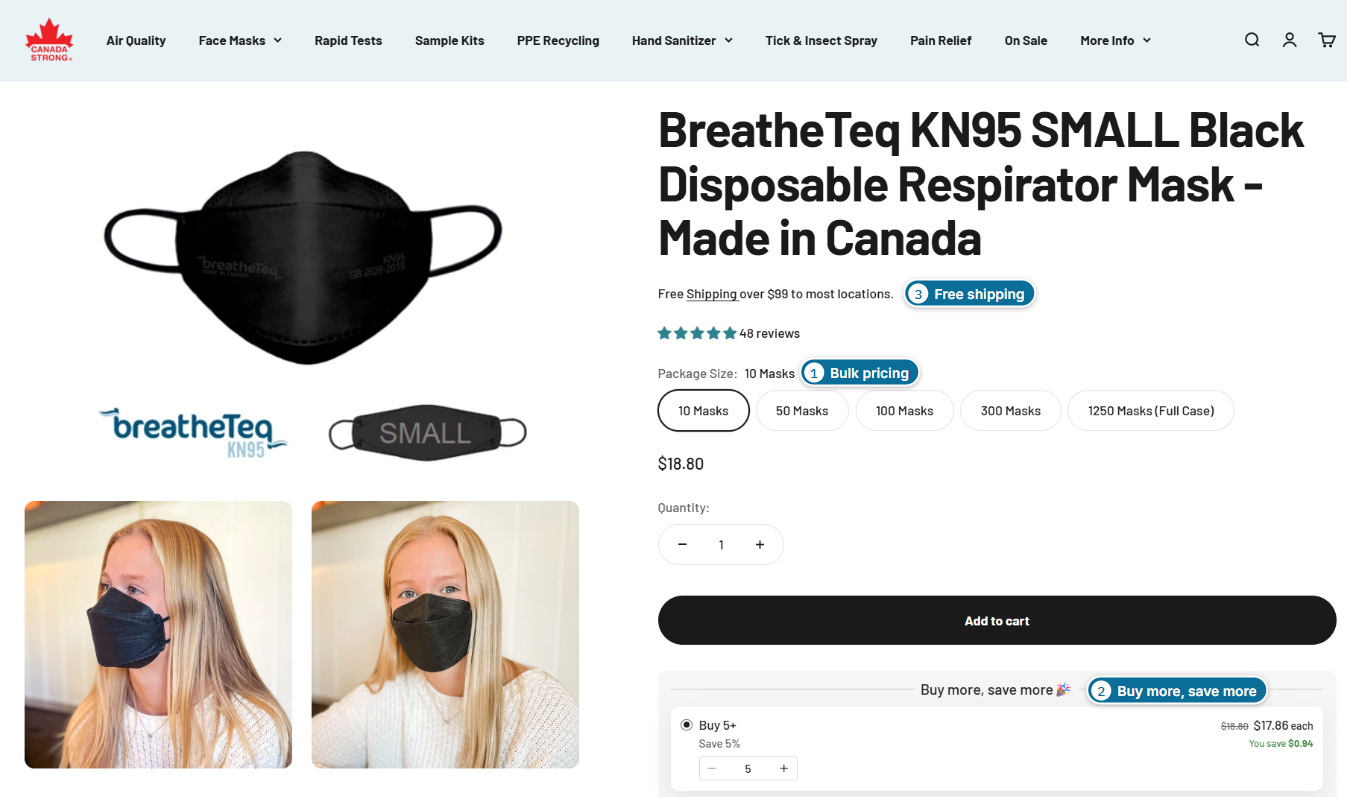
Canada Strong sells KN95 masks in pack sizes ranging from 10 to 1,250 masks. The larger the pack, the lower the price per mask, making the same product page work for both individual shoppers and bulk buyers.
They add three more incentives to encourage larger orders:
-
1
Bulk pricing - Larger packs offer better value per mask, dropping from $1.88 to around $1.60.
-
2
Buy more, save more - Dealeasy gives customers an extra 5% off when they buy five or more packs.
-
3
Free shipping - Orders over $99 qualify for free shipping, giving shoppers another reason to buy more.
How to apply this to your store
- 01Offer multiple pack sizes so customers can choose based on their needs and budget.
- 02Reduce the per-item price for larger quantities to encourage bulk purchases.
- 03Set a free-shipping threshold that encourages shoppers to increase their order value.
Example 2: Pro-Dec
Pro-Dec
 1Bulk pricing
2Free shipping
What you can learn from Pro-Dec
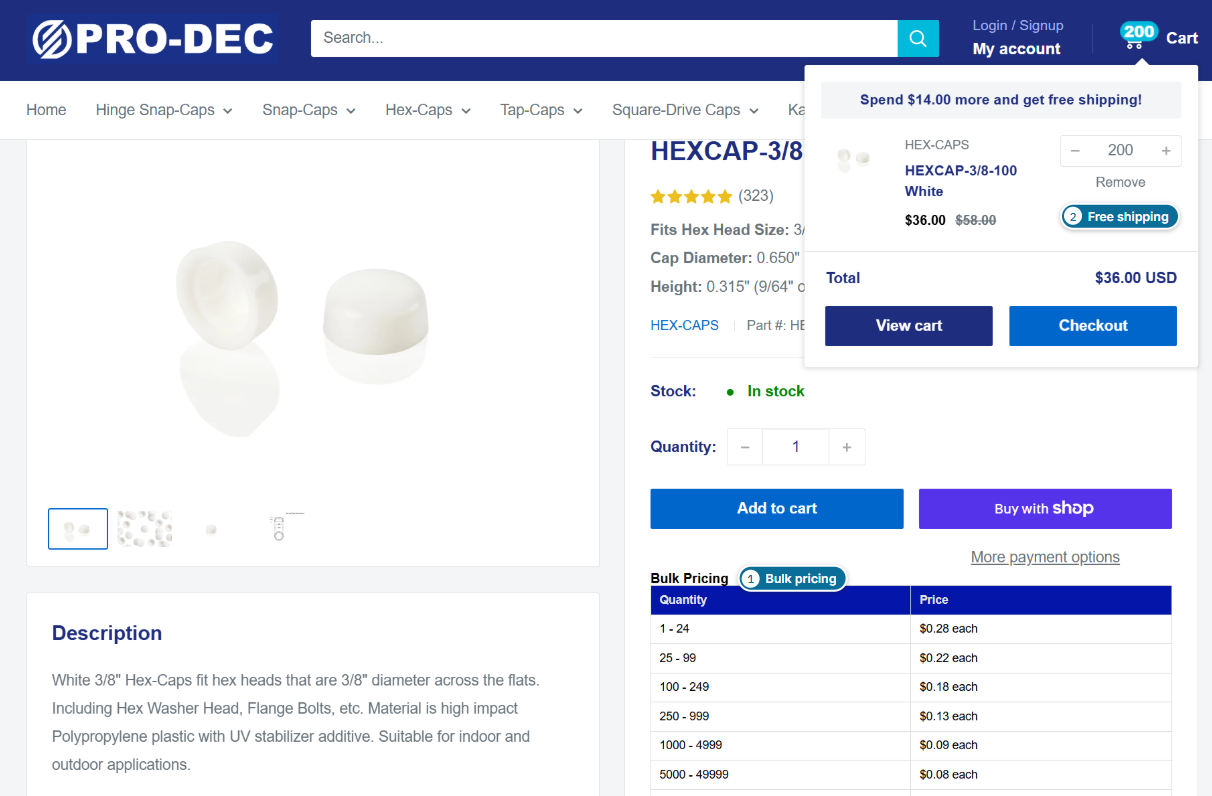
When products cost just a few cents, selling them individually may not be enough to make each order worthwhile. Pro-Dec uses Dealeasy to encourage bulk purchases with tiered pricing displayed directly on the product page.
They make bulk ordering easier in two ways:
-
1
Bulk pricing - Offering lower prices at higher quantities to encourage larger orders.
-
2
Free shipping - Set a $50 threshold to encourage customers to add more to their orders.
How to apply this to your store
- 01Set quantity-based price tiers for low-cost products.
- 02Use a free-shipping threshold to encourage larger orders.
Example 3: Eluxir
Eluxir
 1Popular choice
2Best deal
3Clear savings
4Mix flavours
What you can learn from Eluxir
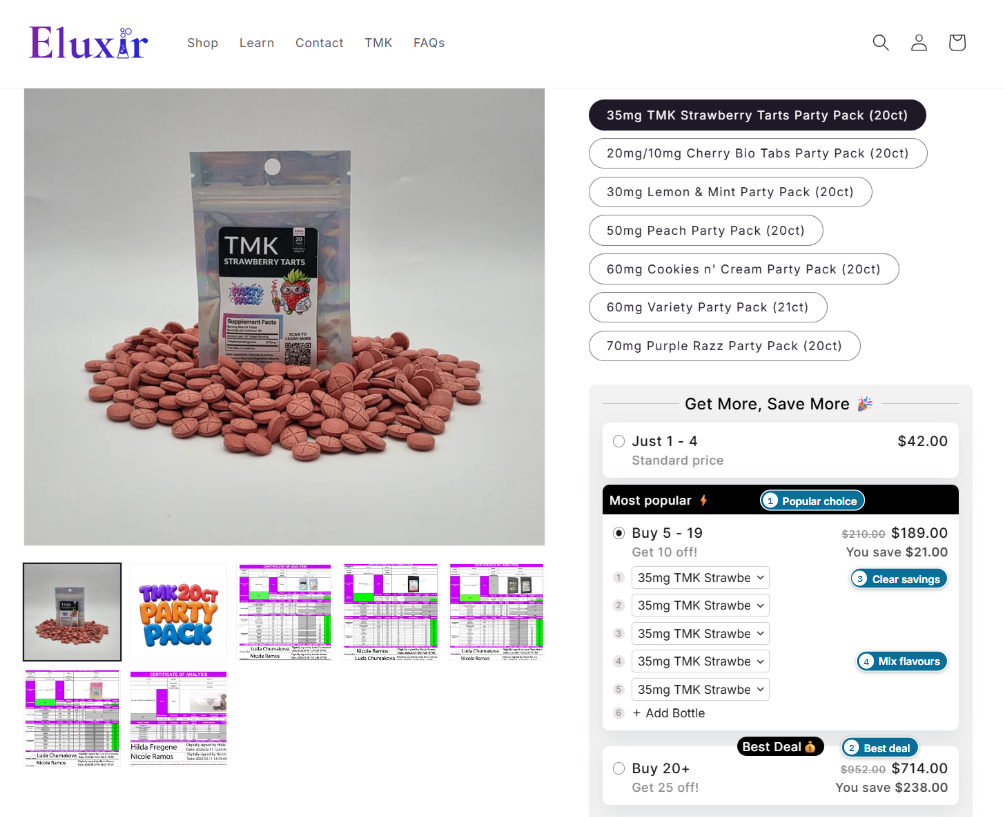
Eluxir uses three pricing tiers to encourage customers to buy more: 1–4 units at $42 each, 5–19 units at 10% off, and 20+ units at 25% off.
They make the offer more appealing with a few simple tactics:
-
1
Highlight the popular choice - Pre-select the 5-pack and label it “Most Popular”.
-
2
Show the best deal - Add a “Best Deal” badge to the 20+ tier.
-
3
Make savings clear - Strike through the original price and show the exact amount saved.
-
4
Offer more choice - Let customers mix flavours within a pack instead of choosing the same flavour for every unit.
How to apply this to your store
- 01Create clear quantity tiers with bigger savings for larger orders.
- 02Highlight a popular tier and make the best-value option easy to spot.
- 03Show customers exactly how much they save.
- 04Allow product variations within a bundle when it makes sense for your products.
Example 4: Giga
GIGA
 1Easy start
2Popular
3Savings
4Next to the decision
What you can learn from GIGA
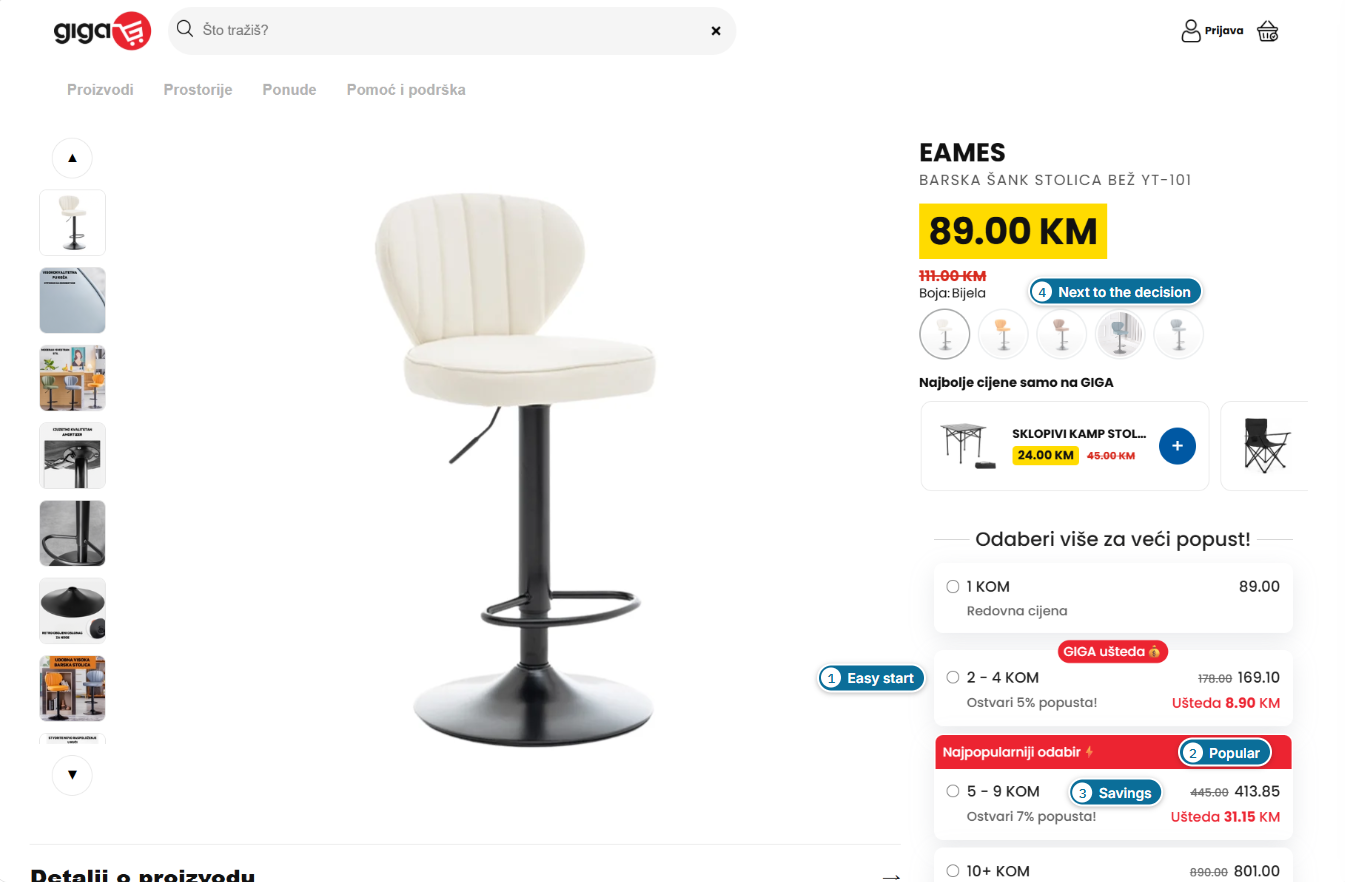
GIGA uses four pricing tiers on its Eames bar stool: 1 unit at 89 KM, 2–4 at 5% off, 5–9 at 7% off, and 10+ at 10% off. Bar stools are usually bought in sets for a kitchen island or café, so the tiers match how customers already shop.
They make the offer more appealing with a few simple tactics:
-
1
Make the first step easy - A small 5% saving on 2–4 stools nudges shoppers to buy a second one.
-
2
Highlight the popular choice - The 5–9 tier has a “Most popular” banner, pointing shoppers to a full set.
-
3
Make savings clear - Each tier strikes through the original price and shows the exact saving in KM, such as “Save 31.15 KM”.
-
4
Keep it next to the buying decision - The tier table sits right below the price and colour options, so shoppers choose quantity and colour together.
How to apply this to your store
- 01Offer volume discounts on products bought in sets, even in categories that are usually one-off purchases.
- 02Start with a small first tier to make adding a second unit easy.
- 03Label the tier you want most shoppers to choose.
- 04Show savings in your currency, not just as a percentage.
Also see how Awards Co used volume discounts to sell personalised products.
Do’s and don’ts: volume discount mistakes to avoid
Most volume discount mistakes come down to three things: giving away too much margin, confusing pricing, and offers shoppers can’t see.
Do’s
- Do the margin check first. For 2 units, keep the discount below half your profit margin; for 3 units, below two-thirds. With a 60% margin, 2 units can go up to 30% off; with a 20% margin, only 10%. Treat these as limits, not targets.
- Start small. Test on one or two repeat-purchase best-sellers before rolling out store-wide.
- Keep it to 2–3 tiers. More than that reads like a price list.
- Show the offer next to Add to Cart, with the price per unit and the saving (“$34 each, save $18”).
- Highlight one tier with a “Most popular” or “Best value” label.
- Measure profit per order, not just AOV, and review your tiers before big sales.
Don’ts
- Don’t discount the first unit. The discount should reward the extra unit, not the first one.
- Don’t let discounts stack by accident. A 15% tier plus a 20% welcome code is 32% off. Check how your discounts combine before launch.
- Don’t create price cliffs. If 9 items at $40 cost $360 but 10 items at $35 cost $350, buying more costs less. Check the total at every tier.
- Don’t make the top tier too generous, or everyone picks it and your margin disappears.
- Don’t run out of stock on a promoted product. It disappoints the customers you just attracted.
Frequently asked questions
1. How do I set up volume discounts on Shopify?
Install a volume discount app like Dealeasy, create an offer with two or three quantity tiers, choose the products, and publish the tier widget on your product page. The discount then applies automatically in the cart and at checkout.
2. What is a good volume discount percentage?
Most stores start with 5-10% off for 2 units and around 15% for 3 or more, if margins allow. As a rule, keep the 2-unit discount below half your profit margin and the 3-unit discount below two-thirds.
3. Does Shopify have built-in volume pricing?
Only for B2B. Shopify’s native volume pricing works through B2B catalogs for company customers, and since 2026 it’s available on all plans. Stores selling to regular shoppers need an app to show tiers on the product page.
4. What is the best volume discount app for Shopify?
Look for an app that shows tiers on the product page, applies discounts through Shopify’s native checkout, supports the discount types you need, and has predictable pricing. Apps like Smart Bundles App & Upsell, Appstle Bundles App & Upsells and Dealeasy are some of the best apps that you can try on your store.
Wrapping up
Volume discounts work when they match how your customers buy and leave room in your margin.
Start with one repeat-purchase best-seller, check your margin, add two or three tiers next to Add to Cart, and compare AOV and profit per order after a few weeks. If customers don’t buy multiples, switch to a cart-based offer instead.